Unlocking the Secrets of OEM Casting for High-Quality Metal Parts
Understanding OEM Casting and Its Importance
What is OEM Casting?
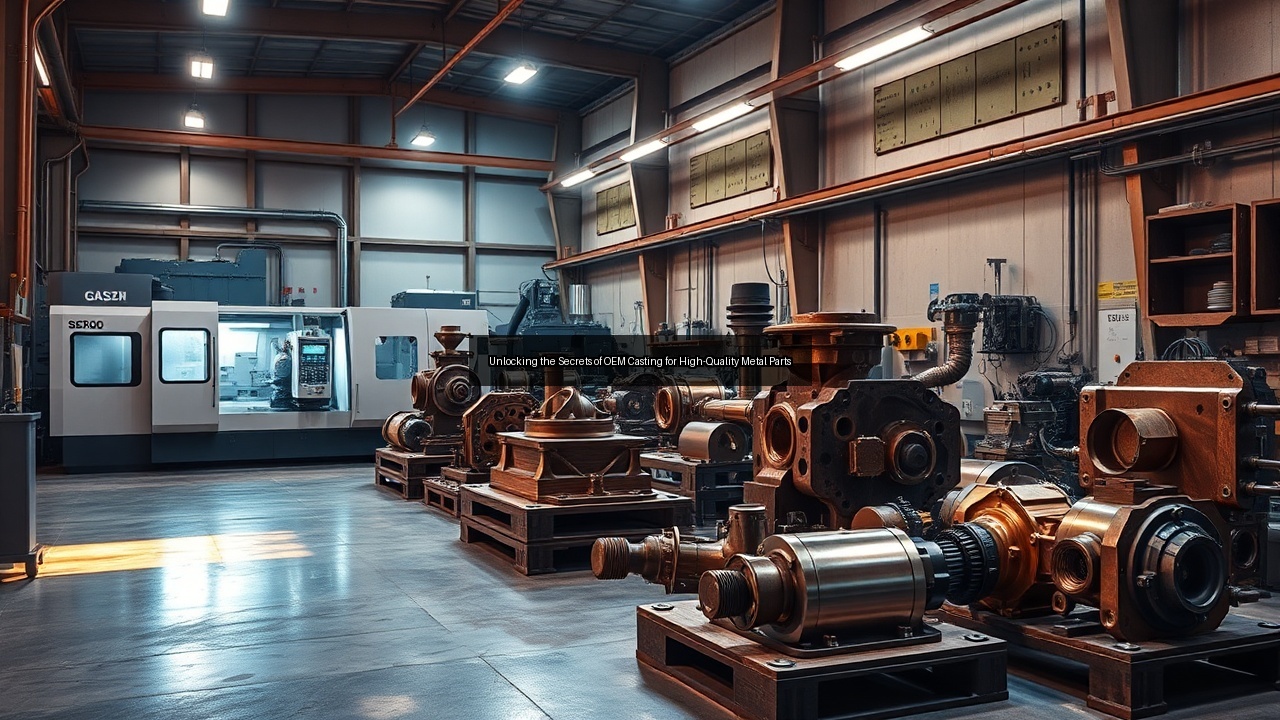
OEM casting delivers precision metal components directly to manufacturers who integrate them into finished products. This process starts with molten metal poured into molds that match exact specifications, creating parts ready for assembly lines. Foundries handle everything from pattern creation to cooling, ensuring each casting meets dimensional tolerances. OEMs rely on this method for consistent supply without maintaining their own production facilities. The approach supports high-volume runs while maintaining quality across batches. Engineers design molds that account for shrinkage and material flow, resulting in components that fit seamlessly into larger systems. This method reduces lead times compared to in-house production and allows access to specialized expertise at dedicated facilities.
Benefits of OEM Casting for Metal Parts
OEM casting produces strong, complex shapes that machining alone cannot achieve efficiently. It lowers material waste through near-net-shape forming and supports rapid prototyping for design iterations. Manufacturers gain cost savings on tooling amortization over large orders while achieving repeatable accuracy. The process accommodates intricate internal features and thin walls without secondary operations in many cases. OEMs benefit from scalable production that matches demand fluctuations. Quality certifications at the foundry level guarantee traceability and defect minimization. Overall, this method streamlines supply chains and delivers parts with superior mechanical properties compared to fabricated alternatives.
Key Industries Utilizing OEM Casting
Automotive suppliers depend on OEM casting for engine blocks and transmission housings that withstand extreme conditions. Aerospace companies use it for lightweight structural elements in aircraft frames. Heavy equipment makers source hydraulic components and gear housings through the same channels. Energy sectors apply OEM castings in turbine parts and valve bodies exposed to high pressure. Agricultural machinery incorporates durable cast iron elements produced via OEM routes. Medical device firms select precision castings for surgical tools requiring biocompatibility. Each industry leverages the process for parts that demand both strength and geometric complexity.
Exploring Different Metal Casting Processes
Investment Casting: Precision and Complexity
Investment casting creates detailed metal parts by coating wax patterns with ceramic slurry before melting out the wax and pouring metal. This technique excels at producing turbine blades and medical implants with fine surface finishes and tight tolerances. OEMs choose investment casting when designs include undercuts or thin sections impossible through other routes. The process supports alloys that require controlled solidification rates. Multiple patterns can cluster on a single tree to boost efficiency. Post-pour operations remain minimal due to the accuracy achieved in the mold. Foundries optimize shell thickness to prevent cracking during high-temperature pours.
Die Casting: Speed and Efficiency
Die casting forces molten metal into reusable steel molds under high pressure, enabling fast cycle times for high-volume production. OEMs apply this method to automotive brackets and consumer electronics housings where consistent wall thickness matters. Aluminium and zinc alloys flow well in these dies, yielding smooth surfaces that need little finishing. The technique reduces porosity through vacuum assistance in advanced setups. Tooling lasts for hundreds of thousands of shots before replacement. Manufacturers monitor injection parameters closely to avoid flash or incomplete fills. Die castings integrate well with subsequent assembly steps.
Sand Casting: Versatility and Cost-Effectiveness
Sand casting uses compacted sand molds that accommodate large or irregularly shaped components. OEMs select this process for prototypes and low-to-medium runs of pump housings or machine bases. Patterns made from wood or metal create the cavity, and cores form internal passages. The method works with nearly any metal and allows easy size scaling. Sand properties such as grain size influence surface quality and casting integrity. Reclamation systems recycle used sand to control costs. This flexibility makes sand casting a staple for custom OEM metal casting projects.
Forging vs. Casting: A Comparative Overview
Forging compresses heated metal between dies to align grain flow and boost strength, while casting solidifies metal from liquid in a mold. OEMs compare both for applications like crankshafts where fatigue resistance counts. Forged parts often show higher impact toughness but require more material removal in machining. Castings capture complex geometries in one step without the directional limitations of forging. Cost analysis favors casting for intricate shapes and forging for simple, high-stress items. Hybrid approaches sometimes combine both processes for optimal performance in final assemblies.
Materials Used in OEM Casting
Ductile Iron vs. Cast Iron: Properties and Applications
Ductile iron offers improved elongation and impact resistance over traditional cast iron due to its nodular graphite structure. OEMs specify ductile iron for crankshafts and suspension arms that endure cyclic loading. Cast iron provides excellent vibration damping and wear resistance in brake drums and engine blocks. Both materials pour at similar temperatures yet differ in nodule formation during solidification. Heat treatment further refines properties in ductile grades. Foundries adjust magnesium additions to control nodularity in ductile iron melts. Selection depends on whether the application prioritizes toughness or compressive strength.
Aluminium in OEM Casting: Lightweight Solutions
Aluminium delivers low density and good corrosion resistance, making it ideal for OEM castings in transportation and electronics. Die castings and investment castings from aluminium alloys reduce vehicle weight while maintaining structural integrity. Thermal conductivity suits heat sinks and cylinder heads. OEM manufacturers control silicon content to improve fluidity during pouring. Anodizing or powder coating enhances surface protection on finished parts. Recycling streams keep material costs competitive. These properties drive adoption across industries seeking efficient metal casting solutions.
Iron Alloys in Casting Processes
Iron alloys form the backbone of many OEM casting projects because of their strength-to-cost ratio. Grey iron variants provide good machinability for valve bodies, while alloyed irons resist abrasion in mining equipment. Melting practices include precise carbon and silicon balancing to achieve target microstructures. OEMs request specific grades for elevated temperature service in exhaust manifolds. Inoculation treatments refine grain size during cooling. These alloys support high-volume production in sand casting and die casting lines alike. Performance data guides material choices for each casting process.
The Role of Machining in OEM Casting
CNC Machining: Enhancing Precision in Cast Parts
CNC machining removes material from castings to achieve final dimensions and surface finishes beyond casting capabilities. OEMs program multi-axis machines to drill precise holes and mill flat mating surfaces on engine components. Tool paths account for casting variations to maintain consistency across batches. Carbide cutters handle both iron and aluminium effectively. Fixture designs secure irregular cast shapes during operations. This step transforms rough castings into ready-to-assemble parts. Integration with CAD models ensures repeatability in high-volume OEM metal casting runs.
Post-Casting Machining Processes
Post-casting machining includes turning, milling, and drilling that refine features created during the initial casting process. OEMs apply these steps to remove gates, risers, and parting lines from die castings and sand castings. Thread tapping and boring operations prepare mounting locations. Coolant management prevents thermal distortion in thin-walled aluminium parts. Sequential operations often follow a single setup to reduce handling. Inspection between stages catches deviations early. These processes complete the transformation from raw casting to functional component.
Quality Control in OEM Machining
Quality control verifies that machined castings meet specifications through coordinate measuring machines and surface profilometers. OEMs implement statistical process control to track dimensional trends during production. Non-destructive testing such as ultrasonic inspection detects internal voids before machining begins. Documentation of each lot supports traceability requirements. Tolerance stack-up analysis prevents assembly issues downstream. Corrective actions adjust machine parameters or tooling when deviations appear. Robust controls maintain the reliability expected from OEM castings.
Choosing the Right OEM Manufacturer for Casting Needs
Evaluating Foundries and Their Capabilities
Foundries demonstrate capability through equipment lists, material certifications, and sample part portfolios. OEMs visit facilities to review mold-making capacity and melting furnace types. Production volume history indicates ability to scale for demand spikes. Certifications such as ISO 9001 confirm process discipline. Technical staff expertise in casting process simulation helps predict and prevent defects. Capacity for secondary machining under one roof simplifies logistics. These factors determine which partner best supports specific OEM metal casting requirements.
Questions to Ask an OEM Manufacturer
Direct questions reveal alignment on lead times, tooling ownership, and defect rates. OEMs inquire about typical alloy availability and minimum order quantities for new projects. Details on quality documentation and corrective action procedures clarify expectations. Discussion of capacity constraints during peak seasons avoids supply disruptions. Inquiries into sustainability practices and material sourcing build confidence in long-term partnerships. Clarification on design assistance and prototyping services guides project planning. Thorough conversations prevent mismatches between capability and need.
Future Trends in OEM Metal Casting
Future trends include additive manufacturing of patterns and cores to accelerate development cycles for OEM castings. Simulation software predicts filling and solidification with increasing accuracy. Automation in foundries reduces labor while improving consistency across casting processes. Lightweight aluminium alloys and advanced ductile iron grades address efficiency demands. Digital twins of production lines enable real-time monitoring and optimization. Sustainability initiatives focus on energy recovery and scrap reduction. These developments position OEM casting as a continued cornerstone of modern manufacturing.